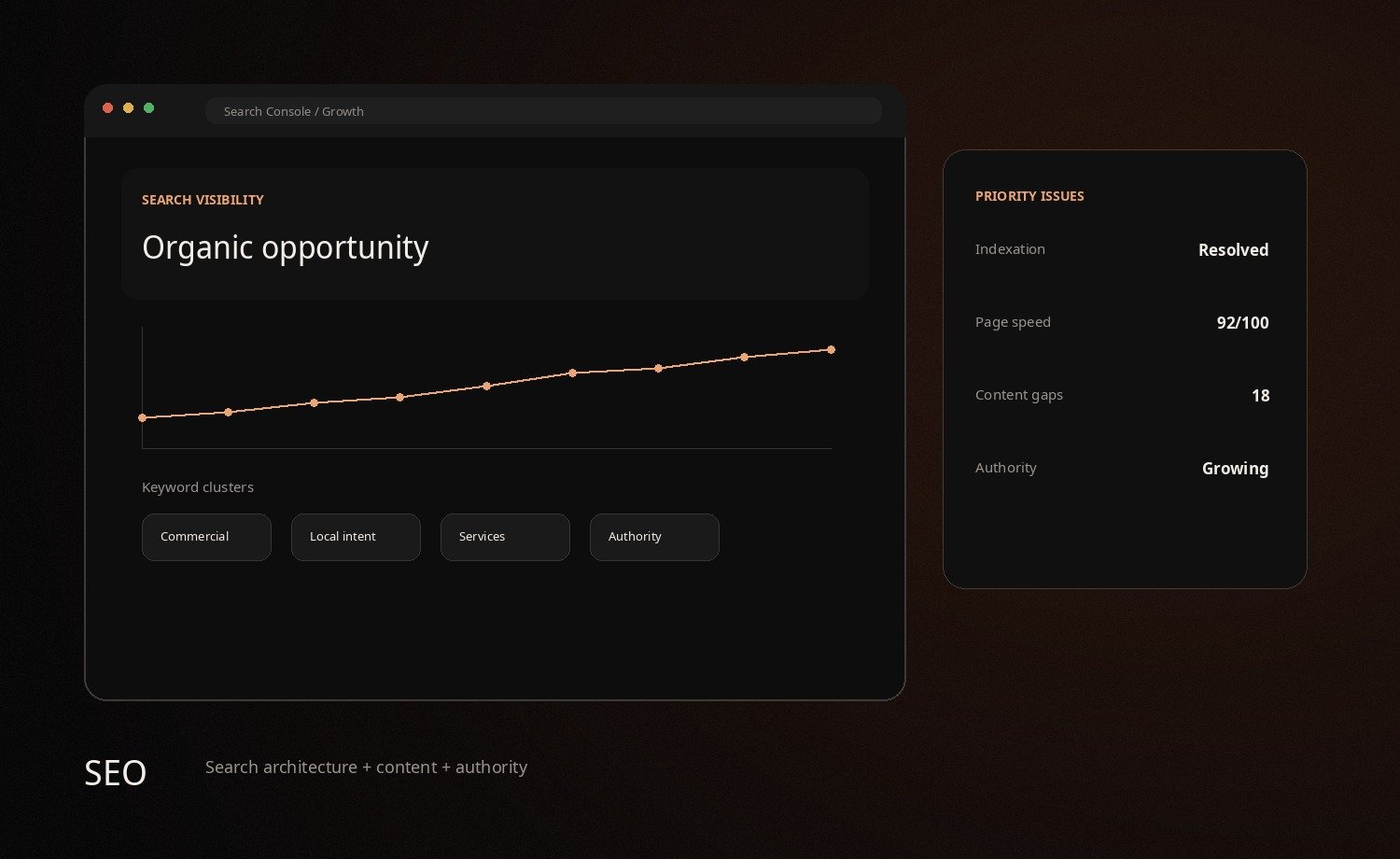
02 / SEOSearch strategy begins with commercial intent, not a spreadsheet of keywords.
SEO is most valuable when it is connected to the way customers actually evaluate a business. We start by separating informational searches from commercial searches, mapping the questions that appear before purchase and identifying the pages that should own each theme. This prevents multiple pages from competing with each other and gives the website a clear role in the buying journey.
The result is a search architecture built around demand rather than volume alone. High-volume keywords can be useful, but qualified intent, relevance and the ability of a page to convert are usually more important. We use competitive research, search behavior and business priorities together so the strategy supports pipeline instead of becoming an isolated traffic project.
03 / SEOTechnical SEO should make the site easier for both search engines and people to understand.
Technical work covers crawlability, indexation, internal linking, page speed, structured data, redirects, duplicate content, mobile behavior and the relationship between templates. We prioritize issues by impact rather than producing a long audit that leaves the team unsure where to begin.
When development resources are limited, the order of operations matters. We distinguish critical barriers from incremental improvements and turn the audit into an implementation roadmap. That makes SEO useful to developers, content teams and decision-makers instead of turning it into a quarterly PDF ritual.
04 / SEOContent should build topical authority and answer the questions that move a buyer forward.
Our content strategy groups related topics into clusters so individual articles support stronger service and category pages. Editorial planning considers what a prospect needs to understand at each stage, which objections are holding them back and where the brand can add something more useful than a rewritten version of existing search results.
Every piece has a job. Some pages capture direct commercial intent. Others create authority, attract links, support internal linking or give sales teams a useful resource to share. That makes the content library a business asset rather than a publishing calendar built around arbitrary frequency.
05 / SEOReporting should connect rankings to qualified visibility and business outcomes.
Rankings are a signal, not the final outcome. We look at non-branded visibility, organic landing-page performance, assisted conversions, lead quality, local actions and the search themes responsible for growth. The reporting model is adapted to the business so the metrics reflect how revenue is actually created.
SEO compounds when technical health, content quality, authority and conversion experience improve together. The objective is not a temporary spike. It is a stronger digital footprint that keeps generating relevant discovery after the initial work is complete.