02 / Lead GenerationLead generation begins by defining who is worth acquiring.
A lead is not valuable because a form was submitted. Before campaigns begin, we define the ideal customer profile, exclusion criteria, buying signals, geography, decision-maker roles and the minimum information required for the sales team to act confidently. This definition becomes the foundation for targeting, messaging and qualification.
Clear qualification prevents the acquisition team from optimizing for volume while the sales team quietly complains about quality. Both sides use the same language and the same stages, which makes performance discussions more useful and budget decisions easier to defend.
03 / Lead GenerationThe offer and landing experience determine whether attention becomes action.
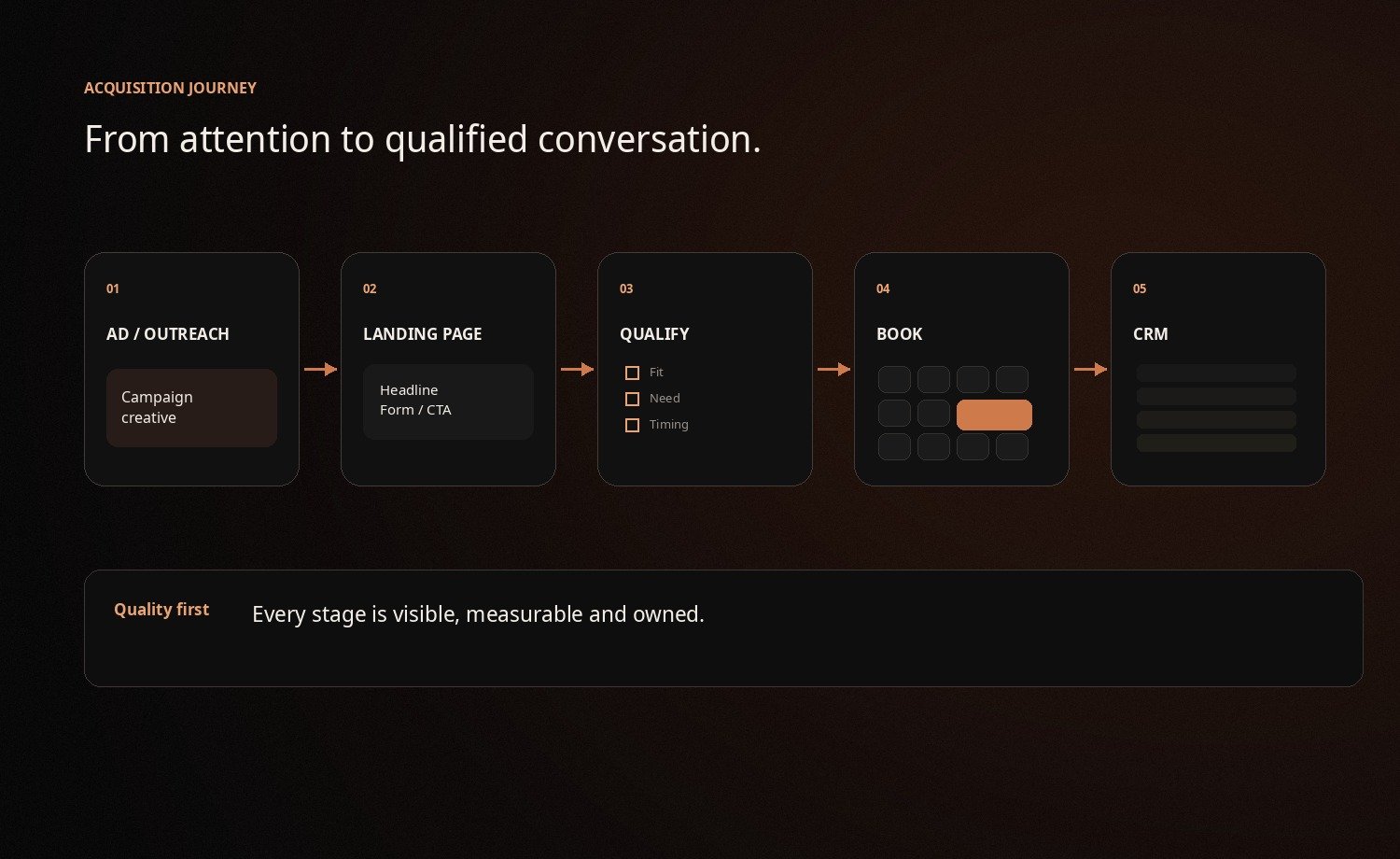
We develop acquisition messages around a real customer problem and a believable next step. Depending on the business, that may be a consultation, assessment, quote, demo, downloadable resource or direct purchase. The landing page is designed to reduce uncertainty and make the value of responding obvious.
Pages are structured around message match, proof, objections, qualification and speed. Forms collect enough information to help the business act without becoming unnecessarily long. When appointment booking is appropriate, calendars and reminders are integrated into the same journey.
04 / Lead GenerationFollow-up speed and routing can change the economics of the entire campaign.
A large percentage of lead-generation waste happens after the lead has already been acquired. We design routing rules, ownership, notifications, email or SMS follow-up and pipeline stages so each enquiry has a clear next action. This prevents good leads from disappearing between marketing and sales.
The CRM should preserve source data and campaign context so the team can see where the opportunity originated and what the prospect responded to. That information improves sales conversations and allows marketing to evaluate quality by source rather than by cost per form fill alone.
05 / Lead GenerationOptimization should move deeper into the funnel over time.
Early campaigns may use cost per lead and qualification rate as initial indicators, but mature reporting should connect source, appointment, opportunity and revenue where the sales cycle permits. That makes it possible to distinguish cheap leads from commercially useful leads.
We use that feedback to improve audience targeting, offers, creative, landing pages and qualification rules. Lead generation becomes a controlled acquisition system rather than a hunt for the lowest headline cost.