← All servicesRevenue operations

CRM Development & Management

We build CRM environments that connect acquisition, follow-up, pipeline stages, automation and reporting so the system mirrors how revenue actually moves through your business.

Discuss CRM Development & Management
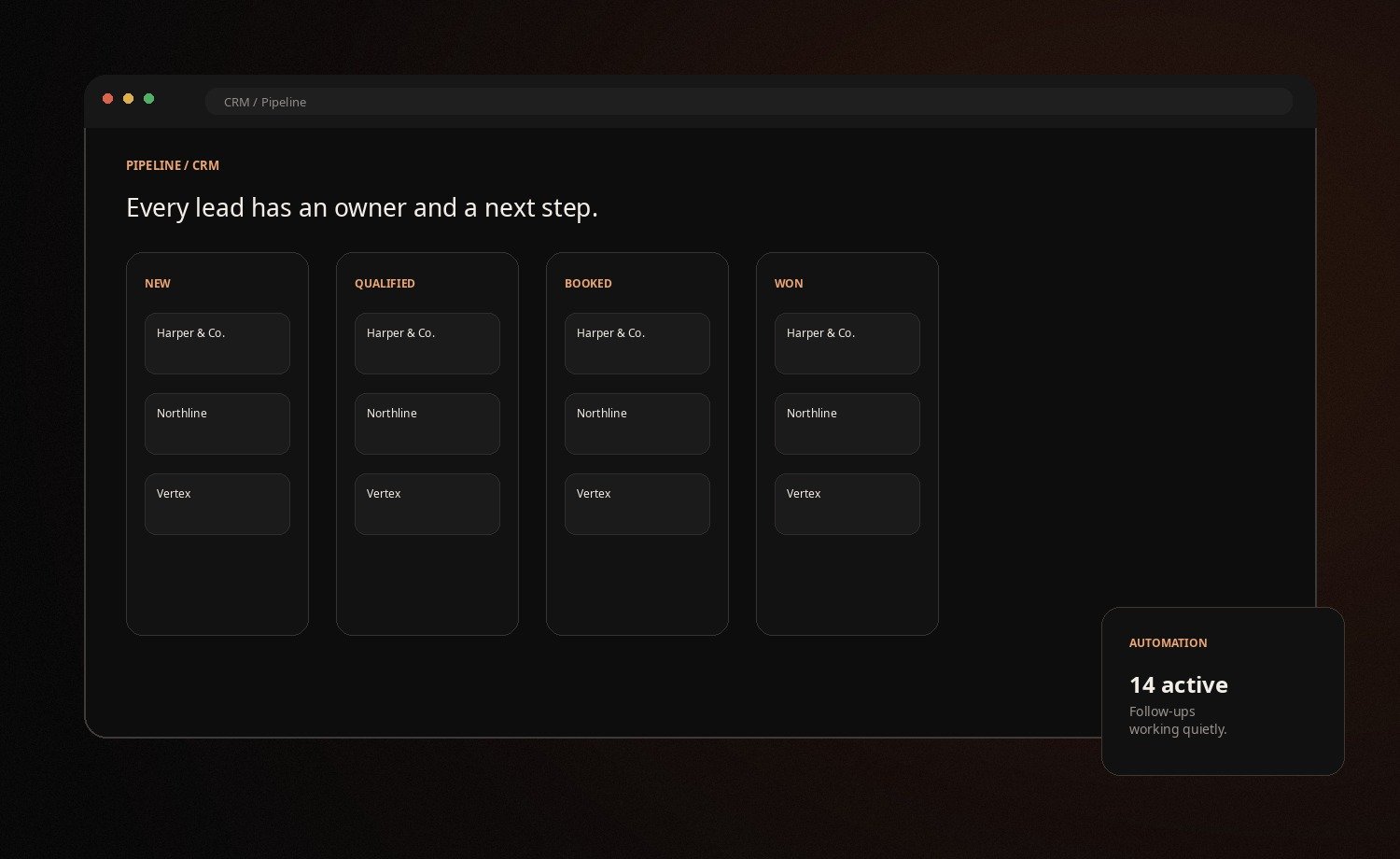
CRM Development & Management service visualisation
01 / The outcome
What the work is designed to change

Make every lead visible, owned and impossible to lose quietly.

Cleaner pipeline visibility, faster follow-up, fewer dropped opportunities and a CRM your team can actually operate.

The engagement begins with the business context: audience, offer, economics, buying journey, existing assets, internal capability and what is already working. The execution follows that logic instead of forcing every business into a standard package.

What can be included

A disciplined scope built around the brief.

The exact combination depends on the objective. These are the core building blocks we use when this service is part of the solution.

01CRM selection and architecture
02Pipeline and lifecycle design
03Lead routing and ownership rules
04Email and SMS automations
05Forms, calendars and integrations
06Reporting dashboards and source attribution
07Ongoing hygiene and optimization
Detailed CRM Development & Management interface and output preview
02 / CRM Development & Management

A CRM should reflect how the business actually sells.

Default software stages rarely match a real sales process. We map how leads enter, who qualifies them, what information is required, how opportunities progress and where ownership changes. The pipeline is then configured around those realities rather than forcing the team to work around generic settings.

Clear stages make reporting possible. If everyone uses different definitions for qualified, booked, proposal or won, the dashboard cannot provide useful insight. We standardize the process so the CRM becomes an operational source of truth.

03 / CRM Development & Management

Automation should remove repetitive work while preserving accountability.

Lead notifications, assignment, reminders, nurture, appointment confirmations, re-engagement and internal tasks can be automated where the rules are predictable. Human action remains visible so the system supports the team instead of hiding responsibility behind automation.

We also design safeguards for common failure points: duplicate contacts, missing ownership, stale opportunities, incomplete fields and leads that have not received a response. These small operational details often have a larger revenue impact than adding another marketing channel.

04 / CRM Development & Management

Marketing and sales data should live in the same story.

Source, campaign, form, service interest and qualification information should travel with the lead. That allows the sales team to understand context and allows marketing to see which sources create real opportunities rather than simply generating submissions.

Dashboards can then report on stage conversion, response time, pipeline value, source quality and team activity. The reporting becomes more useful because it reflects the complete journey from acquisition through sales outcome.

05 / CRM Development & Management

A CRM remains valuable only when the team can operate it consistently.

Implementation includes documentation, naming conventions, permissions and workflow guidance so the system survives beyond launch. We remove unnecessary complexity and design the interface around the people who actually use it every day.

Ongoing management can include data hygiene, workflow adjustments, new automations and reporting improvements as the business changes. The objective is a living operating system, not a one-time setup that slowly becomes unusable.

How the work moves

Enough process to create quality. Not enough to create theatre.

Each stage exists to remove assumptions, improve the work and keep progress visible.

01

Discover

We map current tools, sales stages, handoffs, bottlenecks and reporting gaps.

02

Blueprint

The CRM is designed around the business process, not around default software settings.

03

Build

Pipelines, custom fields, automations, forms, integrations and dashboards are implemented.

04

Operate

Documentation, team enablement and ongoing cleanup keep the system useful after launch.

Questions

Useful things to know before we start.

A strong brief usually starts with fewer assumptions and better questions.

Yes. We can clean up and rebuild existing setups or recommend a better architecture when the current system is fundamentally mismatched.

That is the point. Lead source, campaign context, qualification, sales stage and follow-up should live in one connected flow.

Ongoing management, reporting, workflow changes and data hygiene can be included.

A good place to begin

Make the next version of your brand harder to ignore.

Bring us the growth problem, the positioning problem, the scattered channels or the website that no longer feels like the business it represents.

Talk to us